

FAQs
Why Vottiv does not offer relational organizing
Relational organizing is a campaign strategy built around reaching voters through people they already know. In practice, that usually means asking volunteers to upload their phone contacts, matching those contacts against the campaign’s voter file, and then prompting volunteers to send campaign-written messages to friends and family from their personal numbers.
People are more likely to listen to someone they know than to a campaign. We think that’s true.
We spent a lot of time considering whether Vottiv should build relational organizing. We read the research, sketched out what the product would look like, and tested it internally more than once before deciding against it.
The decision had less to do with whether relational outreach can work than with what it asks a volunteer to spend.
The hidden cost
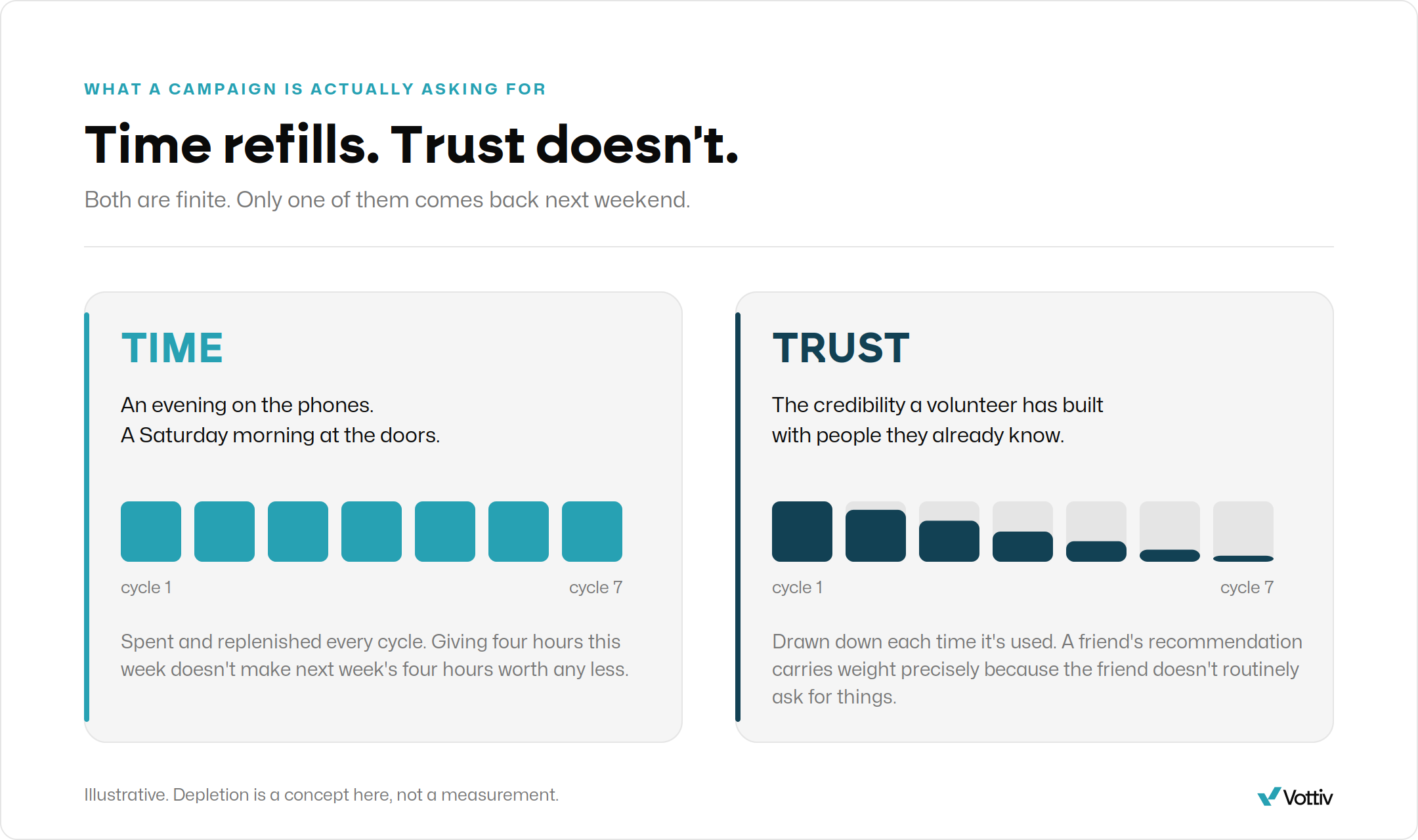
Campaigns usually ask volunteers for time: an evening on the phones, a Saturday morning at the doors.
Relational organizing asks for something more personal, the trust a volunteer has accumulated with people they know.
That trust is valuable precisely because it isn’t spent constantly, and a recommendation from a friend carries weight when it’s selective. Someone who ignores ten campaign texts might still take a friend’s political message seriously, for the simple reason that the friend doesn’t routinely ask for things.
There are obviously moments when using that credibility makes sense. A volunteer may know exactly which friend would welcome a conversation about a race, which neighbor has been asking questions, or which family member genuinely enjoys talking politics.
But those decisions depend on context, and context is where relational organizing gets uncomfortable for us.
What happens over time
A field experiment can tell you whether a relational message changes behavior in one election. It’s much harder to measure what happens after several cycles of asking volunteers to turn personal relationships into campaign infrastructure.
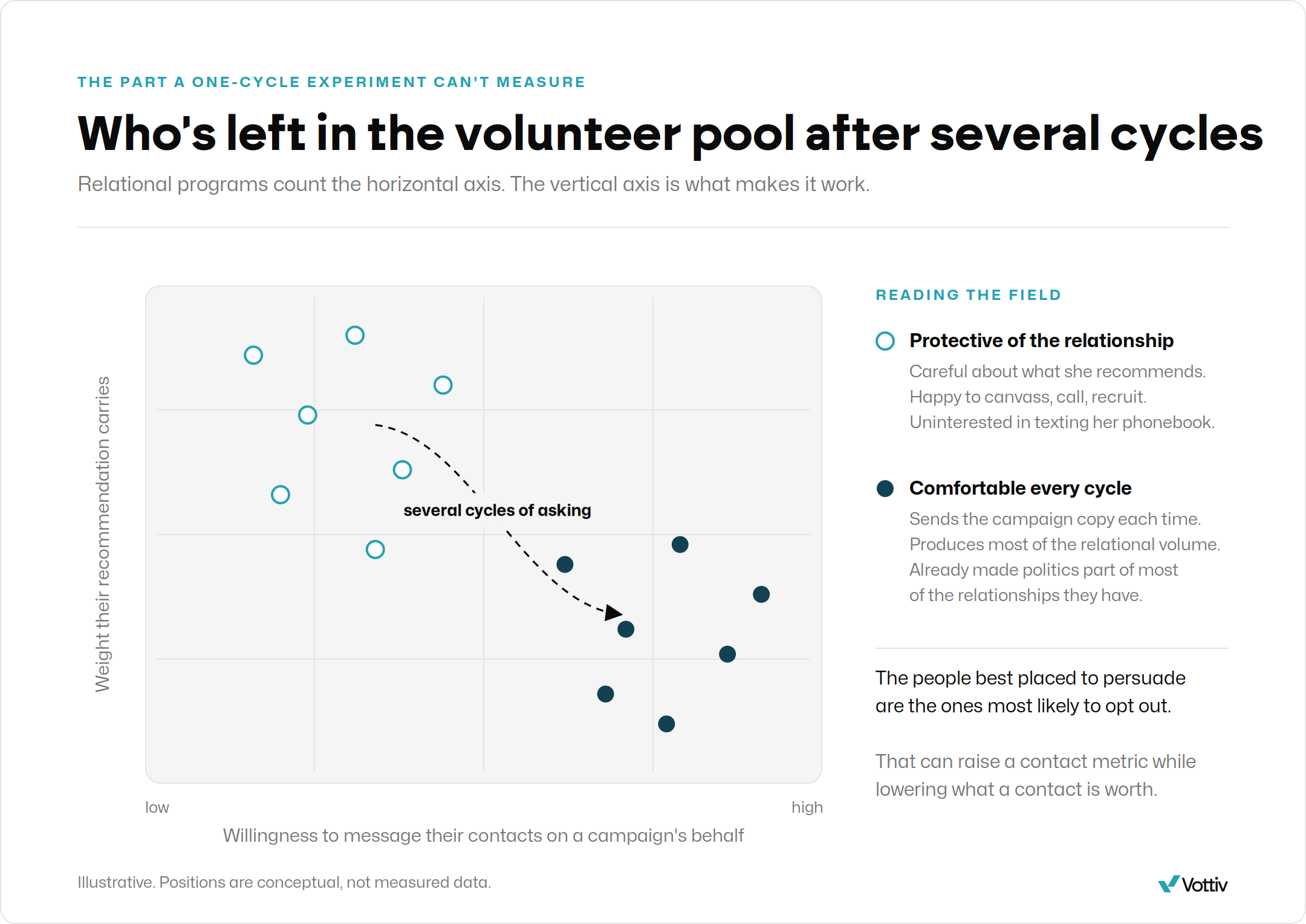
Consider the volunteer whose opinion carries real weight among friends, who’s careful about what she recommends. She may happily canvass for hours, make calls, or recruit people to an event, while having no interest in sending campaign copy to everyone in her phone.
Now consider the volunteer who’s perfectly comfortable doing that every cycle.
One of those people is likely to produce more relational messages. The other may have more credibility to begin with.
That’s the long-term concern. If campaigns make personal relationships part of the expected cost of volunteering, the people most protective of those relationships may gradually opt out, leaving a volunteer pool increasingly dominated by people comfortable making politics part of nearly every relationship they have.
That may improve a short-term contact metric; we’re less convinced it improves the health of the industry’s volunteer base.
What the research says
The most frequently cited evidence for relational organizing comes from a Center for Campaign Innovation field test involving low-propensity Republican voters in Florida during the 2024 cycle.
The study reported that voters contacted by someone they knew were 8.6 percentage points more likely to turn out. A peer-to-peer texting arm of roughly 100,000 messages showed no measurable turnout effect.
That’s an interesting result, and one of the reasons we took the category seriously. The public write-up also leaves some important questions open.
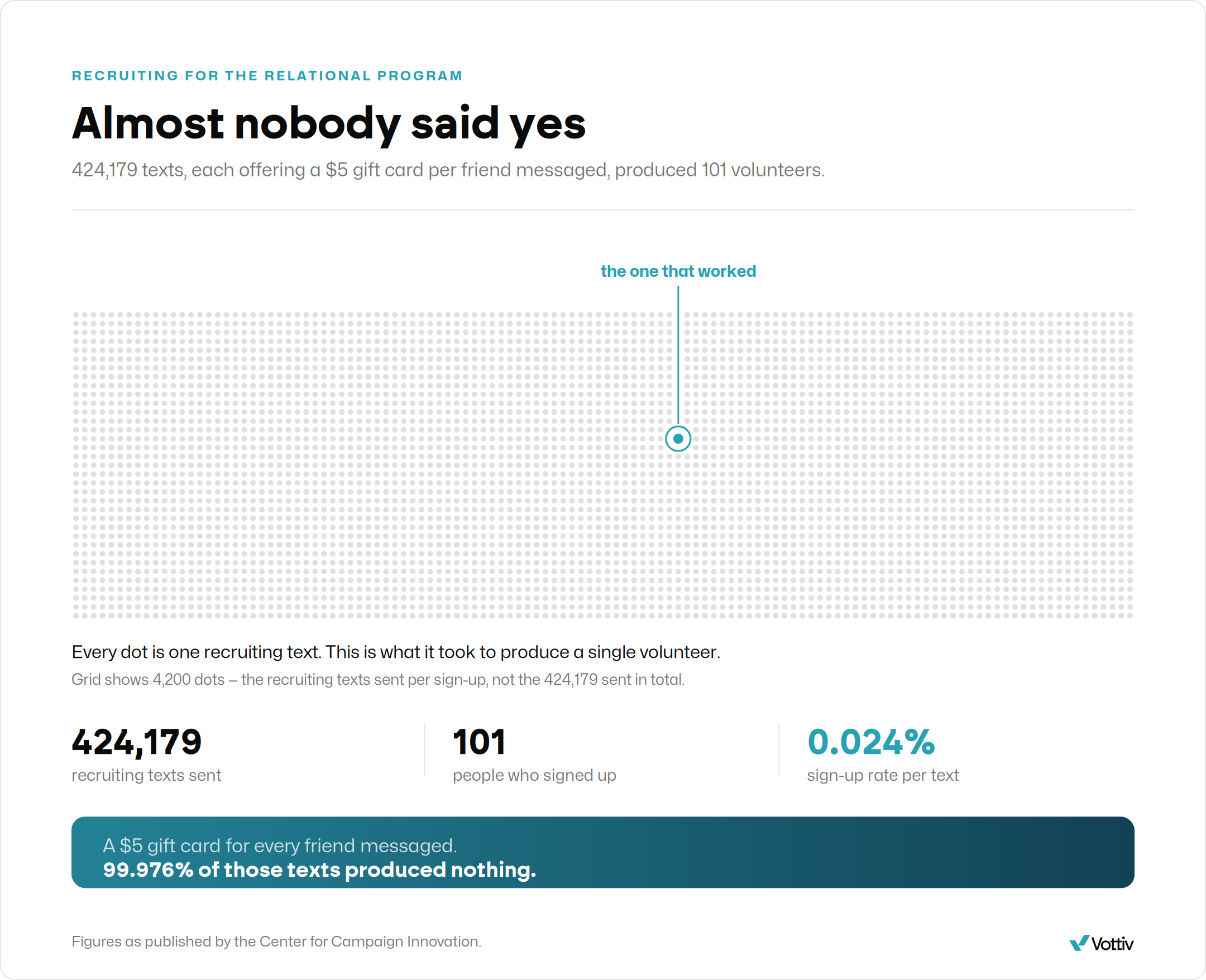
Researchers began with 538,078 registered Republicans and sent 424,179 recruiting texts offering volunteers a $5 gift card for every friend they agreed to message. 101 people signed up. Those volunteers ultimately texted 1,738 voters, with a quarter of matched contacts held back as a control group.
So the headline result comes from less than two thousand voters in one state during one cycle, and the published write-up doesn’t include the turnout rate for each arm, a confidence interval, a standard error, or a p-value.
There’s also a methodological question around who ultimately counted as "treated". The platform showed volunteers their matched contacts and let them pick who to message. Because people naturally start with closer relationships, volunteer judgment may affect who receives outreach in ways that also correlate with turnout.
The public write-up doesn’t make the exact comparison clear enough for us to know how much that matters. That doesn’t make the result meaningless, but it does make us more cautious than some of the marketing claims built around it.
Scale is another issue. Producing 101 volunteers required 424,179 recruiting texts, which works out to roughly 244 recruiting messages for every relational message eventually sent. To us, that sounds incredibly ineffective.
Even if future research resolves every one of those questions in favor of relational organizing, our product decision would probably stay the same. The harder problem is still what repeated political asks do to the relationships and volunteers campaigns depend on over time.
What we optimize for instead
Vottiv is built around making the time someone intentionally gives a campaign as useful as possible. If a volunteer gives you 90 minutes, we want those 90 minutes spent talking to voters rather than downloading software, creating accounts, figuring out routes, or wrestling with campaign systems.
Canvassing runs from a link or a QR code. For phone banking, volunteers enter a 6-character code at phone.vottiv.com, and texting goes through the campaign’s own infrastructure, which keeps the volunteer’s personal number private and gives the campaign a complete record of conversations and opt-outs.
The work comes back as usable campaign data: doors knocked, survey responses, call dispositions, GPS paths, active minutes, and timesheets.
We also try to use proximity in ways that don’t require an address book. Canvass routes can be assigned geographically, so campaigns can put volunteers in neighborhoods they actually know. A neighbor at the door often has an advantage over someone who drove in from somewhere else, and the campaign can benefit from that without importing anyone’s contacts.
Where relationships still matter
Volunteers should absolutely talk to people they know when they think the conversation makes sense. Those may be some of the most persuasive conversations a campaign gets.
We’d rather leave the choice with the volunteer. Give supporters useful information, make it easy to share a campaign link, and trust them to know which relationships are appropriate for a political ask. Their judgment is part of the value.
Why Vottiv doesn’t have relational organizing
We like the insight behind relational organizing. People trust people they know, and campaigns benefit enormously from volunteers who have credibility in their communities. We just don’t want to turn that credibility into another channel to be optimized.
Our job is to help ordinary volunteers be more effective when they choose to give a campaign their time, while leaving their personal relationships in their hands.
If there’s something you’re trying to accomplish that Vottiv doesn’t currently cover, email [email protected] and tell us about it. We’d rather understand the underlying problem than build a feature just because the category is popular.
Was this article helpful?